Monday, 23 July 2018

Nokia 3.1 with 5.2-inch HD+ display, MediaTek chipset launched in India


A day after the launch of the X5 in China, HMD Global, a Nokia brand licensee, has launched their newest mid-range offering, the Nokia 3.1, today, in India. The new smartphone runs on Android Oreo and comes with a MediaTek chipset. Nokia had previously launched the 3.1 in Europe back in May 2018.

Nokia 3.1

The Nokia 3.1 sports a 5.2-inch HD+ IPS LCD screen with a resolution of 720×1440 pixels. A 2.5D curved Corning Gorilla Glass protects the 18:9 display from potential scratches. Underneath the hood, the phone comes powered by an octa-core MediaTek 6750N chipset with Mali-T860 MP2 GPU. It comes with 2 GB RAM and 16 GB of internal storage. The phone runs on Android 8.0 Oreo.
Ajey Mehta, Vice President, and Country Head – India, HMD Global, says:
“India is one of our top markets and Indian consumers, a top priority for us. We work to constantly enhance the experience on our phones to better suit the everyday needs of our consumers. Every single detail on a Nokia smartphone is designed with consumers in mind, which is why we are delighted to introduce a further refined Nokia 3.1 smartphone that delivers a dramatic step up on performance, continues to drive the most premium design elements and delivers the class-leading quality that you expect from us. We are delighted that we have been able to raise the bar on our most successful model for our consumers.”
The Nokia 3.1 comes with a 13 MP rear-facing camera with a f/2.0 aperture, paired with an LED flash. The selfie camera on the front uses an 8 MP sensor that sits behind a similar f/2.0 lens that has an 84.6° wide field of view.
A 2990 mAh battery provides the necessary juice for the smartphone to run. For connectivity, the phone comes with 4G VoLTE, Bluetooth 4.1 LE, 802.11 a/b/g/n Wi-Fi and GPS. The phone lacks both the fingerprint scanner as well as face unlock.
Nokia 3.1 Colors

Pricing and Availability of Nokia 3.1

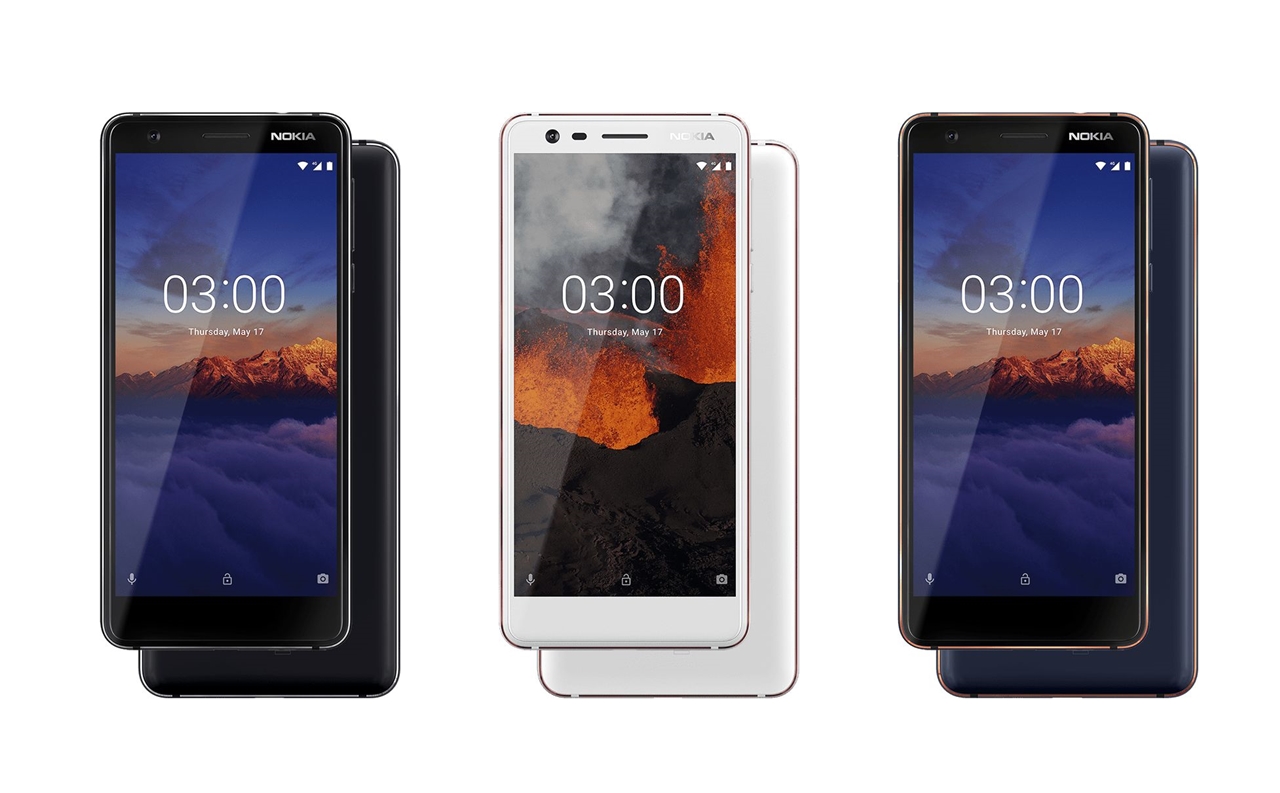
The Nokia 3.1 comes in three color options – Black with Chrome accents, Blue with Copper accents & White with Iron accents. The pricing of the phone comes at INR 10,499, and the sale will start on July 21st. The phone will be available for purchase across all major retail outlets and will be sold online exclusively on Nokia.com and PayTM Mall.
The Nokia 3.1 comes with few launch offers such as:
· Consumers buying Nokia 3.1 from a retail outlet by scanning the Paytm Mall QR code will get 10% cashback on recharges and bill payments on Paytm.
· Buyers will additionally get two INR 250 movie cashback vouchers which can be redeemed against booking minimum two movie tickets via Paytm.
· Consumers using ICICI Bank Credit or Debit Card will get a 5% cashback.
· Idea and Vodafone consumers will get two exciting offers. On a recharge of INR 149 pack, they will get 1GB data/day, unlimited calls and 100 SMS/day for 28 days; additionally, consumers upgrading from 2G or 3G phone to the new Nokia 3.1 will get 1GB data/day for 28 days. On recharge of INR 595, consumers will get unlimited calls, 100 SMS/day, 18GB data for six months.
Learn more: 3.1

Corning Gorilla Glass 6 unveiled with 2x damage resistance than Gorilla Glass 5

Corning Gorilla Glass 6
Corning has announced their sixth iteration of the Gorilla Glass, the Corning Gorilla Glass 6, today. “On an average, the Corning Gorilla Glass 6 is said to have survived 15 drops from a height of 1 meters onto rough surfaces, when tested in lab conditions. When other competitive glasses were subjected to similar drop tests, the glasses didn’t even survive the first drop,” claimed Corning.

Corning Gorilla Glass 6

“Gorilla Glass 6 is an entirely new glass composition that can be chemically strengthened to give it significantly higher levels of compression than is possible with Gorilla Glass 5. This enables Gorilla Glass 6 to be more resistant to damage. Moreover, with breaks during drops being a probabilistic event, the added compression helps increase, on average, the likelihood of survival through multiple drop events,”
said Dr. Jaymin Amin, vice president of technology and product development, Corning Gorilla Glass and Corning Specialty Materials.
The Gorilla Glass 6 is twice as durable as the outgoing Gorilla Glass 5, while still having the same scratch resistance as the latter. This durability is achieved due to significantly higher compression capacity than the Gorilla Glass 5.
“As consumers become more dependent on their smartphones, the opportunity for potentially damaging drops is also on the rise. Now more than ever, it’s critical the cover glass provides outstanding protection. Corning Gorilla Glass 6 improves upon Gorilla® Glass 5 by surviving drops from higher heights, but, more importantly, has been engineered to survive multiple drops,”
said John Bayne, vice president and general manager, Corning Gorilla Glass.
Since phones these days come with larger displays, as well as smartphone manufacturers opting for glass backs on their smartphones, making them two times more prone to shattering. With its optical capability, touch sensitivity, scratch resistance efficient wireless charging and enhanced durability, Corning Gorilla Glass 6 will be able to withstand the growing need for all glass smartphones, with better drop resistance than its predecessors. Corning Gorilla Glass has been designed into more than 6 billion devices by more than 45 major brands.

Availability of Corning Gorilla Glass 6

Corning Gorilla Glass 6 is currently under evaluation by potential customers and will be reaching the markets in the coming months.
Learn more: Gorilla Glass 6

Oppo F9, F9 Pro Leaked Teaser Surfaces, Bluetooth Certification Hints at 3 Models

oppo f9 teaser dealntech Oppo F9
Photo Credit: DealnTech
Nearly four months after bringing the display notch-featuring F7, Oppo is now reportedly preparing the launch of the Oppo F9 and F9 Pro. Both new smartphones have allegedly been spotted on the Bluetooth certification website. Separately, a leaked teaser image showing the latest handset ahead of any formal confirmation has reached the Web. The alleged teaser that hasn't been shared by the Chinese company suggests that the new Oppo models may include a dual rear camera setup along with an LED flash module. Contrarily, the Oppo F7 that was launched in March had a single rear camera setup. A pattern also appears on the teaser image that could a sign for an all-new back panel on the upcoming handset.

The teaser, courtesy tech blog DealNTech, shows that Oppo is set to launch the F9 as its mid-range smartphone. While the provided teaser image doesn't reveal any launch schedule, it does include a render indicating the availability of a horizontally-placed dual rear camera setup on the new model. There is also a patterned background in the teaser that suggests us a uniquely-designed patterned back on the handset. Notably, we already saw a Diamond Black patterned back panel on the F7.
As a successor to the Oppo F7, we can expect an AI-backed imaging experience on the Oppo F9 and Oppo F9 Pro. The presence of the secondary image sensor at the back is also likely to help blur the background. Moreover, the new models are likely to retain the display notch design. The F7 was importantly the company's first model to have a display notch - matching many other Android devices and, of course, the iconic iPhone X.
To recall, the Oppo F7 was launched in India back in March with a starting price of Rs. 21,990. The handset had 4GB of RAM and 64GB of onboard, though there was the F7 128GB variant that included 6GB of RAM. Furthermore, it featured a 6.23-inch full-HD+ Full Screen 2.0 display with a 19:9 aspect ratio and run Android 8.1 Oreo-based ColorOS 5.0

Samsung Galaxy S9, Galaxy S9+ Receive AR Emoji Update; Get 480fps Super Slow Motion Mode

Samsung Galaxy S9, Galaxy S9+ Receive AR Emoji Update; Get 480fps Super Slow Motion Mode
While the tech world is anticipating the arrival of the Galaxy Note 9, Samsung has brought a couple of updates for the Galaxy S9 and Galaxy S9+ to please its existing users. The first update in the new series is the addition of customisation options to the AR Emoji feature that debuted to counter Apple's Animoji. The South Korean giant has also offered an improved facial tracking to enhance the 3D emoji experience. It has additionally been spotted that users with the latest update containing the July security patch are now able to record super slow-motion videos at 480fps for up to 0.4 seconds. This comes in addition to the default 960fps super slow motion mode that still exists for videos being recorded in the auto mode.
To convince more people to start sharing AR Emoji messages, Samsung has now brought a plethora of customisations in the form of the new My Emoji Editor feature. With the new My Emoji Editor, users will be able to make adjustments to their hair style, skin colour, skin tone, as well as facial features like cheeks, chin, ears, and neck. "With the update, after users snap a selfie to generate their AR Emoji, they'll be able to easily make detailed adjustments to their AR Emoji's hair, ears, and facial features. This means that, for instance, when a child creates an AR Emoji, they'll be able to adjust the shape of their face so that it more closely mirrors their own," the company said in a in a statement while announcing the new AR Emoji update.
samsung my emoji editor gadgets 360 Samsung AR Emoji update
Alongside customisations, Samsung has improved the face-tracking function of AR Emoji with a 65-percent increase in 'landmark detector' points. This new tweak will help your Galaxy S9 or Galaxy S9+ to track features such as your eyes and mouth more precisely. Furthermore, there is a frame rate boost to make the movements of your virtual face smoother and more natural.

Wednesday, 18 July 2018

Samsung Galaxy Note 9 Leaked Render Shows New Back Panel, S Pen in Multi-Colour Paintjob; Hands-On Images Surface

Samsung Galaxy Note 9 Leaked Render Shows New Back Panel, S Pen in Multi-Colour Paintjob; Hands-On Images Surface
Samsung Galaxy Note 8
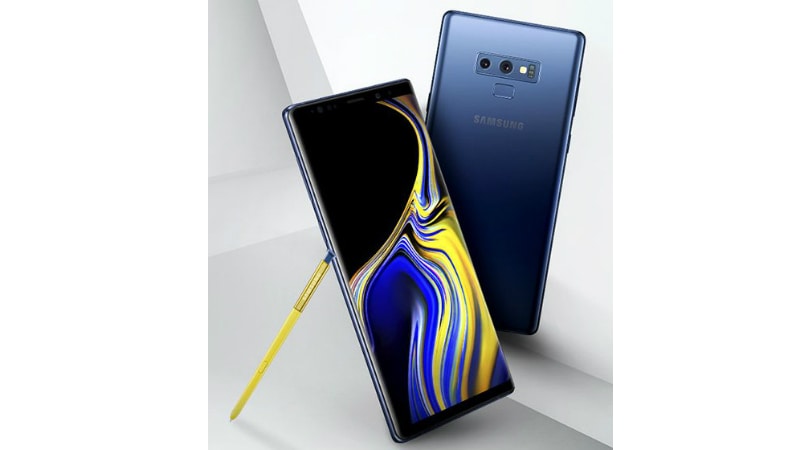
Samsung Galaxy Note 9 is set to launch on August 9, and new leaks appear to be coming in daily. The latest is a leaked render that shows design changes over last year's Galaxy Note 8. The render also shows the new S Pen that is said to include various enhancements, including the rumoured Bluetooth connectivity support. Separately, a couple of hands-on images of the upcoming Galaxy Note model has been leaked. The latest developments come weeks ahead of the formal launch of the Galaxy Note 9 that is set for August 9. Recently, Samsung CEO DJ Koh was spotted using the new Galaxy Note handset at a media briefing that suggested the all-new fingerprint sensor placement. An alleged Geekbench listing additionally tipped that instead of the Exynos 9810 SoC for the global Galaxy Note 8 successor, the South Korean giant could pick the Exynos 9820 SoC.
samsung galaxy note 9 render twitter evan blass Evan Blass
Photo Credit: Twitter/ Evan Blass
The first ever high-quality render of the Galaxy Note 9 has been leaked by none other than renowned tipster Evan Blass. The render shows that while the overall design of the Galaxy Note 9 matches its predecessor, the new model has a bunch of differences when it comes to the back panel. The biggest difference is apparently the position of the fingerprint sensor that has been moved from the vertical-positioned sensor next to the dual rear camera setup that was featured on the Galaxy Note 8 last year to a horizontal-oriented sensor. This sits below the camera setup - all this has been seen before. Notably, the Galaxy S9 family earlier this year also included a horizontal-oriented sensor below the camera module to make the experience more ergonomic for users than the vertical sensor featured on the Galaxy S8. The new placement could help reduce accidental touches to the camera sensors.

Google Hit With Record EUR 4.34 Billion Fine Over 'Illegal' Android Strategy: EU

Google Hit With Record EUR 4.34 Billion Fine Over 'Illegal' Android Strategy: EU
EU regulators hit Google with a record EUR 4.34 billion ($5 billion or roughly Rs. 34,300 crores) antitrust fine on Wednesday for using its Android mobile operating system to squeeze out rivals.
The penalty is nearly double the previous record of EUR 2.4 billion (roughly Rs. 19,100 crores) which the US tech company was ordered to pay last year over its online shopping search service.
The fine represents just over two weeks of revenue for Google parent Alphabet and would scarcely dent its cash reserves of $102.9 billion (roughly Rs. 7 lakh crores). But it could add to a brewing trade war between Brussels and Washington.
Google said it would appeal the fine.
EU antitrust chief Vestager's boss, Commission President Jean-Claude Juncker, is due to meet US President Donald Trump at the White House next Wednesday in an effort to avert threatened new tariffs on EU cars amid Trump's complaints over the US trade deficit.
Vestager also ordered Google to halt anti-competitive practices in contractual deals with smartphone makers and telecoms providers within 90 days or face additional penalties of up to 5 percent of parent Alphabet's average daily worldwide turnover.
"Google has used Android as a vehicle to cement the dominance of its search engine. These practices have denied rivals the chance to innovate and compete on the merits. They have denied European consumers the benefits of effective competition in the important mobile sphere," she said in a statement.
The EU enforcer dismissed Google's argument of competition from Apple, saying the iPhone maker was not a sufficient constraint because of its higher prices and switching costs for users.
Android, which runs about 80 percent of the world's smartphones according to market research firm Strategy Analytics, is the most important case out of a trio of antitrust cases against Google.
Some major Android device makers, including Samsung Electronics Co, Sony Corp, Lenovo Group and TCL Corp, declined to comment on the EU case.
Regulatory action against tech giants like Google and Facebook with their entrenched market power may lack sting, said Polar Capital fund manager Ben Rogoff, who has been holding the stock since its initial public offering and is broadly neutral on Google.
"The reality is that as long as they're delivering great utility to their consumers, consumers will still use those platforms. If they do, advertisers will be drawn to those platforms, too, because the ROIs (return on investment) are very difficult to replicate anywhere else," he said.
The EU takedown of Google is six to eight years too late, with users paying the price, said Geoff Blaber of CCS Insight.
"Any action by the EU is akin to shutting the stable door after the horse has bolted," he said.
"There is a significant danger of unintended consequences that penalises the consumer. This ranges from increased fragmentation and greater app inconsistency to increases in hardware cost should Google decide to change or adapt the Android business model."
Lobbying group FairSearch, whose 2013 complaint triggered the EU investigation, welcomed the ruling.
A third EU case, which has not yet concluded, involves Google's AdSenseproduct. Competition authorities have said Google prevented third parties using its product from displaying search advertisements from Google's competitors.
  • Vestager has also ordered a series of measures against other US companies over tax practices in some EU states, notably demanding two years ago that the Irish government take back up to EUR 13 billion (roughly Rs. 1.03 lakh crores) from Apple.

Vodafone Rs. 199 Recharge Upgraded, Now Offers Up to 2.8GB Daily Data to Rival Jio

Vodafone Rs. 199 Recharge Upgraded, Now Offers Up to 2.8GB Daily Data to Rival Jio
The Vodafone Rs. 199 recharge competes with the Jio Rs. 198 recharge that offers 2GB data per day
Vodafone has reportedly refreshed the base offering in its unlimited prepaid pack basket to now offer double data compared to the previous standard, for select customers. The telecom operator's Rs. 199 prepaid pack is now said to come with benefits of up to 2.8GB 3G/ 4G data per day with the same validity of 28 days. This gives users a combined data limit of 78.4GB for the entire period. The Rs. 199 pack is also said to come with unlimited voice calls with daily and weekly FUP limits, but no SMS message benefits.
As per a report by TelecomTalk, Vodafone has refreshed its Rs. 199 prepaid pack to now offer 2.8GB data per day. Previously, the same pack offered 1.4GB of data on a daily basis. However the pack is available only for a few select users currently. Add to that, it will only be applicable in circles where Vodafone has 4G operations in; the Andhra Pradesh & Telangana and the Madhya Pradesh & Chhattisgarh circles will thus not be eligible.
Talking about the unlimited calling benefits on the revised Rs. 199 plan, there is a daily fair usage policy of 250 minutes and a weekly limit of 1,000 minutes. Effectively, this pack brings down the per GB cost to just about Rs. 2.54.
The Rs. 199 Vodafone pack now betters Jio's Rs. 198 prepaid pack that currently offers 2GB of 4G data per day, unlimited voice calls, and 100 SMS messages per day. The Jio offering also comes with complimentary subscription to Jio's suite of apps that include the likes of Jio TV, Jio News, Jio Cinema, and others.
In other Vodafone news, the telco is heating up the battle in the premium postpaid segment. Vodafone Red postpaid plans were refreshed in June to now offer maximum benefits along with access to services such as Amazon Prime Video and Netflix. Some of the Vodafone Red plans even come with bundled ISD benefits.